
Reditus B2B Buyer Model | Section 7
Emergence: How System-Level Outcomes Arise
No single actor selects the outcome. Outcomes emerge from what the system can sustain.
From the paper
No one ever decided to kill the deal.
In fact, if you asked anyone involved, they would tell you the opposite. The solution was strong. The vendor was capable. The problem was real. At various points, almost everyone had supported moving forward.
It just… never quite happened.
The first few meetings were energetic. The problem statement landed cleanly. Leaders agreed it mattered. A task force was formed. Calendars filled. Momentum felt real.
As weeks passed, the work continued. Demos were attended. Questions were answered. Concerns were logged and addressed. Each meeting ended with a sense of progress, even if no decision was made.
Then small shifts began to accumulate.
A reorg moved one executive’s role slightly out of scope. An audit tightened another’s tolerance for change. A missed forecast pulled Finance into near-term containment. None of these were related to the purchase itself.
But they changed who could carry what.
One person became more cautious. Another stopped pushing. A third shifted from advocate to observer without announcing it. No one reversed their position outright. They simply stopped advancing it.
The vendor noticed the cadence slow. Meetings were still happening, but farther apart. Follow-ups took longer. The questions became narrower, more defensive.
Internally, no one escalated. There was no confrontation. No “no.”
The deal lingered in a space where it was always under consideration, but never quite ready.
Eventually, someone suggested a pause. Not a rejection. Just space.
“Let’s come back to this next quarter.”
Everyone agreed.
By then, the system had changed again. New priorities and pressures. New constraints.
When the topic resurfaced months later, it felt oddly distant, as if it belonged to a different organization.
From the outside, it looked like indecision. From the inside, it felt like a series of reasonable responses to changing conditions.
No single person chose delay. No single objection stopped progress. No single moment defined the outcome.
The system simply moved where it could.
And where it could not, it didn’t.
What emerged was not the best possible decision.
It was the only one the system could sustain.
The buyer is a system-level phenomenon. Not an individual. Not even a committee.
Individuals evaluate personal consequence through identity utility and selfish utility. Those evaluations define a tolerance curve.
Multiple implied decisions are evaluated against the same tolerance curve. Committees consist of multiple individuals, each with their own curve. From this, system-level outcomes follow.
When multiple constrained decisions must align at the same time, outcomes are determined by which combinations fall within tolerance across the system.
Outcomes Are Not Selected. They Emerge.
In complex buying environments, no single actor selects the outcome directly. Instead, outcomes emerge from the interaction of multiple constrained decisions evaluated in parallel.
A purchase occurs only when:
- all required implied decisions fall within tolerance
- for enough individuals
- at the same moment in time
When this condition is not met, the system does not “fail to decide.” It produces a different outcome.
No single actor selects the outcome. Outcomes emerge from what the system can sustain.
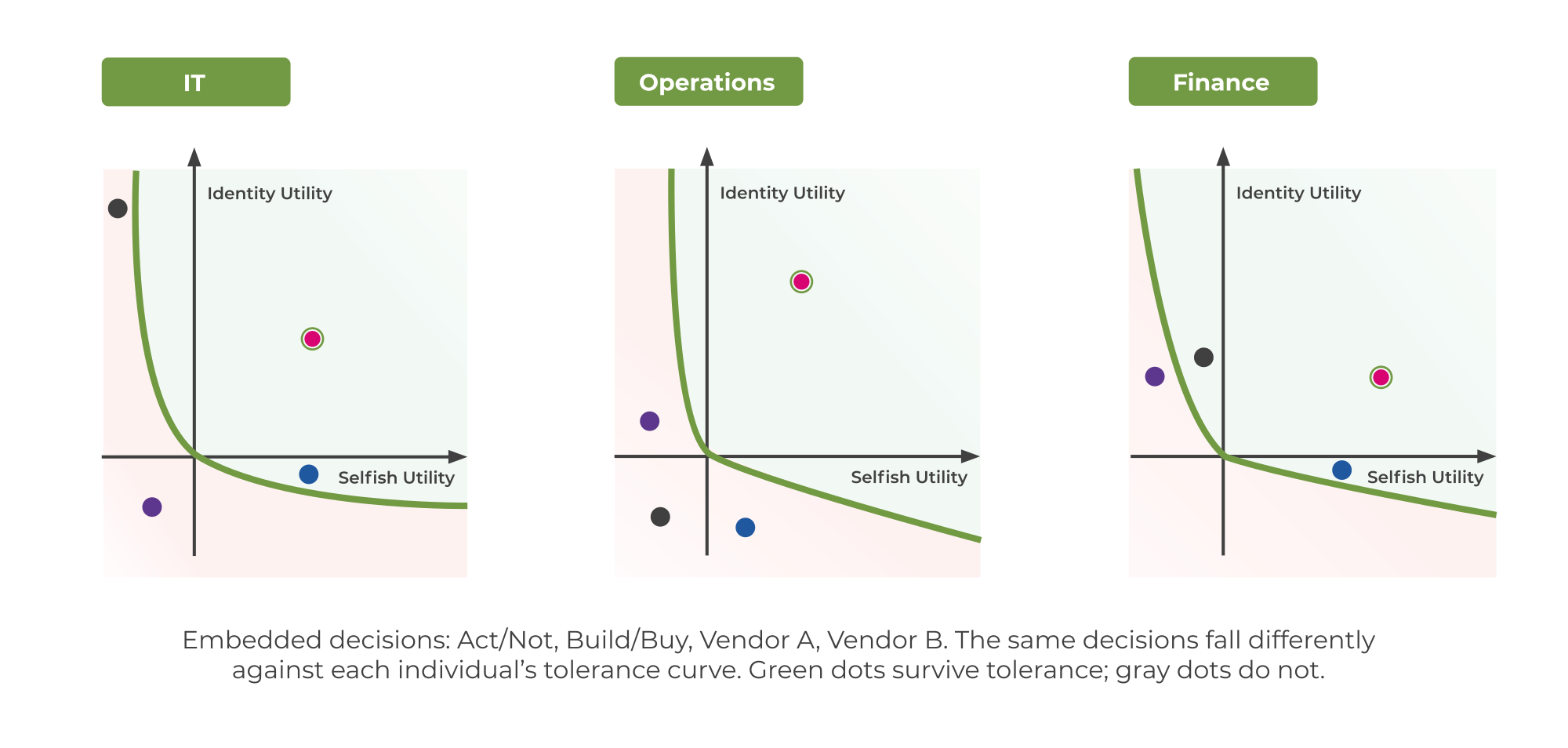
Timing is especially constraining. Even when a workable configuration exists, if individuals’ tolerance curves shift between evaluation and commitment, alignment dissolves. This explains why momentum matters and why “coming back to it later” often fails. The system is no longer the same system.
Inaction, delay, partial commitment, internal build, or selection of a suboptimal vendor are not anomalies. They are stable outcomes given the system’s constraints.
Why Repeated Patterns Appear Across Organizations
Because the underlying mechanics are consistent, the same patterns recur across companies, industries, and buying contexts.
For example:
- “Do nothing” dominates early-stage decisions
- Internal build is favored when visibility is high
- Safer vendors outperform more differentiated ones
- Decisions collapse late without new information
These are not cultural quirks or individual failures. They are predictable outputs of constrained systems.
Organizations differ in surface behavior, but the structural logic is the same. What varies is how consequence is distributed through roles, accountability, and decision rights, and how individuals’ tolerance curves are shaped by culture, recent history, and workload. The mechanics remain constant. The parameters change.
Why Intent and Alignment Are Insufficient
Organizations often attempt to drive outcomes through:
- executive sponsorship
- strategic alignment
- urgency messaging
- top-down mandates
Executive sponsorship can shift tolerance curves by redistributing consequence. When an executive visibly backs a decision, it changes blame distribution, provides air cover if the decision fails, and alters how the action is perceived socially. This is not persuasion – it is a change in who bears downside. However, executive sponsorship alone cannot force convergence if fundamental identity or selfish utility constraints remain unaddressed for other stakeholders.
Strategic alignment efforts reframe decisions as organizational priorities without changing who bears personal consequence when outcomes materialize.
Urgency messaging does not change where decisions fall relative to tolerance. It increases stress, which typically narrows tolerance curves rather than expanding them – making convergence less likely, not more.
These efforts fail when they do not change tolerance curves or the positions of decisions relative to them.
Intent does not override constraint. A system cannot produce outcomes that exceed what its participants can tolerate, regardless of declared priority.
Why Friction Persists Even When Value Is Clear
One of the most common misconceptions in complex buying is that friction signals misunderstanding or resistance.
Within this model, friction is structural.
When decisions fall within tolerance for some individuals but not others, no configuration exists that satisfies all constraints simultaneously.
This produces motion without progress:
- meetings without decisions
- analysis without commitment
- engagement without closure
The system is active, but constrained.
Friction is not resistance. It is the system signaling constraint.
Stability, Not Optimization
The tolerance-curve model explains why organizations make suboptimal decisions, and why they tend towards stable ones.
Optimization requires alignment across tolerance curves toward a shared best outcome. Stability requires only that no participant is pushed beyond tolerance.
Stable outcomes are those that minimize personal exposure, preserve identity coherence and avoid irreversible commitment.
This explains why:
- suboptimal outcomes persist
- inefficient processes survive
- better alternatives fail to displace incumbents
These are not system failures. They are successful constraint satisfaction.
The system produces the decision it can sustain, not the decision that maximizes organizational value.
Implication
Complex buying behavior cannot be explained by persuasion, incentives, or rational comparison alone.
It is the emergent result of:
- how consequence is distributed
- how individuals evaluate that consequence
- how multiple implied decisions fall relative to tolerance curves
- and how those tolerances overlap across a committee
Until those constraints change, outcomes will not.
Understanding buying behavior therefore requires understanding the system, not just the people within it.
FOUNDATIONAL PAPER
The Reditus B2B Buyer Model
Consequence, Power, and Decision Emergence in Complex B2B Buying. Read the complete paper by Craig T. Watkins.
Get in Touch
If what you’ve read here resonates, begin with a quick check on fit.
No pitch. No pressure. Just context.