
REDITUS STARTUP LIFECYCLE
Stage 1: Hypothesis
A company exits Hypothesis when a real company agrees to act as a committed beta customer who will participate in shaping, using, and validating the emerging solution.

The Hypothesis stage is the origin point of every B2B tech startup. At this stage, the founder holds a belief about a problem, who experiences it, why it matters, and how a solution might create value. The belief may come from direct experience, deep domain expertise, exposure to an underserved workflow, or recognition that new technology makes a solution possible. Regardless of the source, the belief has not yet been tested with a real customer.
The purpose of the Hypothesis stage is to articulate the problem clearly enough to determine whether it is worth exploring with the market. This includes identifying the likely customer type, understanding the context in which the problem arises, and forming an initial point of view on the expected value. What matters at this stage is clarity of thought, not proof. Founders often cycle through multiple versions of their hypothesis as they begin conversations and observe initial reactions.
What the Hypothesis stage does not provide is evidence. Founders may feel confident in the problem, but confidence is not validation. Until a real customer engages with the idea, the startup remains in the realm of assumptions. Customer interviews can help shape the hypothesis, but they do not satisfy the need for concrete commitment or behavior. They provide insight, not validation.
Interviews ≠ Validation
Feedback ≠ Evidence
Enthusiasm ≠ Commitment
Internal Conviction ≠ External Traction
A company remains in the Hypothesis stage if it has not yet secured a beta customer willing to work alongside the founder to shape and use the emerging solution. This is the gate that determines readiness to move forward. When a real customer agrees to participate, to share their workflow, to test the solution, and to support its development, the startup exits Hypothesis and enters Market Co-Creation.
Without securing a beta customer committed to real deployment, the startup risks landing in a pilot or POC that never reveals the critical lessons the next stage surfaces: the true stakeholder map, operational constraints, real friction, authentic buyer language, actual value in practice, and whether the solution would be adopted at a market- realistic price.
Startup Lifecycle Whitepaper
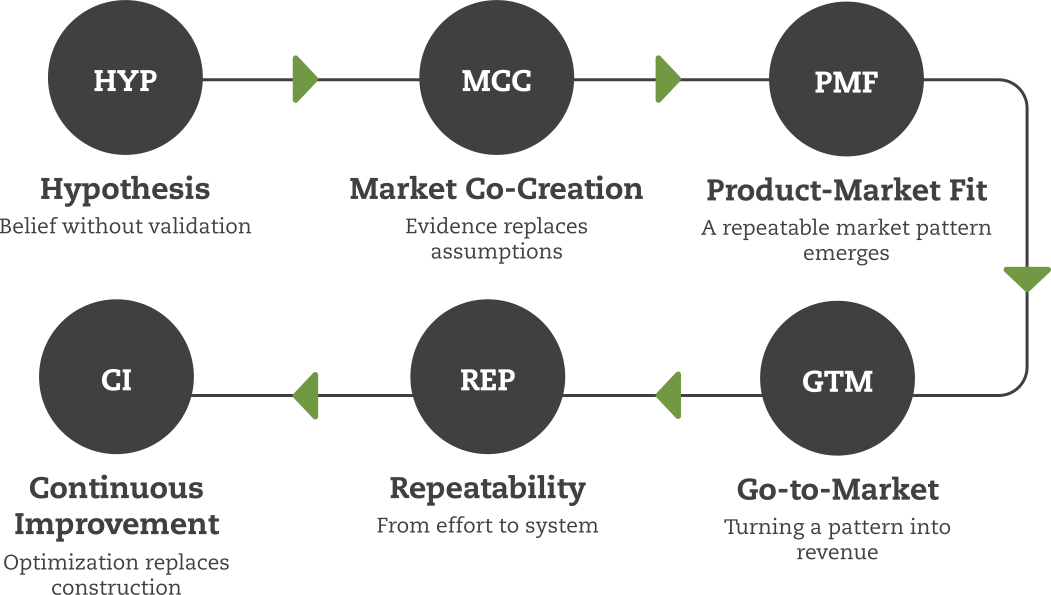
Read about the six-step startup lifecycle model defined by Reditus in this free whitepaper.
Get in Touch
If what you’ve read here resonates, begin with a quick check on fit.
No pitch. No pressure. Just context.