
REDITUS STARTUP LIFECYCLE
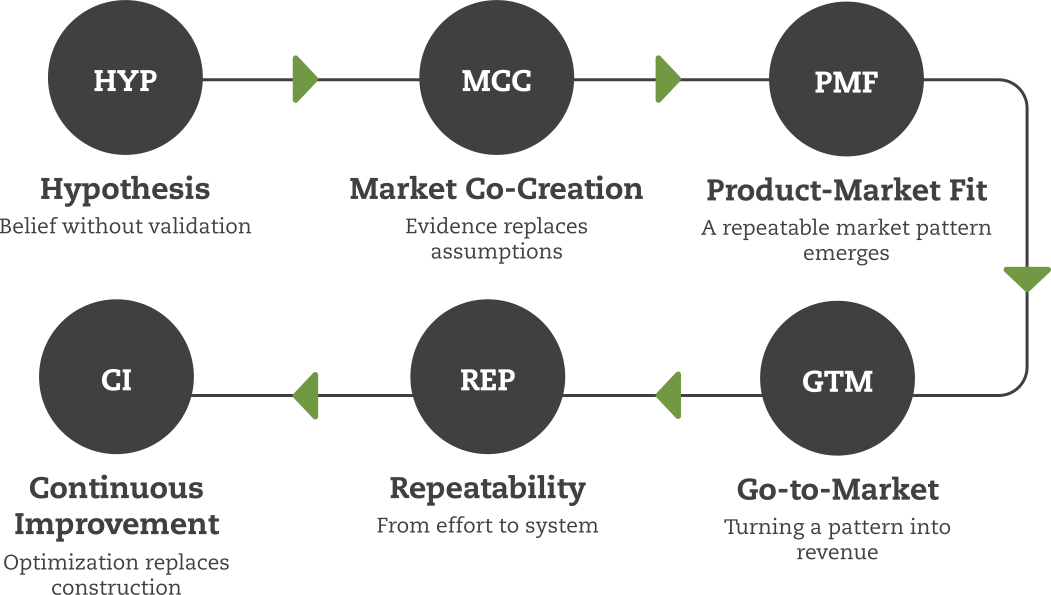
Stage 2: Market Co-Creation
A company exits MCC when at least one real customer has deployed the solution in an actual workflow, continues using it, endorses its value, is willing to support a reference and case study, confirms that the solution would still be worth adopting at a non- symbolic, market- realistic price, and the startup has incorporated both product and market learnings into positioning.

Market Co-Creation (MCC) is the stage where the startup implements its solution at one or more beta customers inside a real workflow and learns how the market actually functions around that solution. This is the first point in the lifecycle where the company generates evidence, not opinions. MCC proves that the solution works end to end for a real organization, used by real stakeholders, under real conditions.
The purpose of MCC is simple: convert assumptions into evidence through deployment and direct market interaction. Many early-stage teams misinterpret enthusiasm, design feedback, or pilot conversations as validation. In the current AI hype cycle, rapid product building often reinforces this mistake by making a demo look like market readiness.
Without a true deployment, founders request the wrong resources, such as sales and marketing support, when what they actually need is the ability to deliver, support, and observe an MVP in a live environment and understand how buying and adoption truly occur.
MCC Tradeoff: Cost Now vs. Cost Later
Running MCC with a single beta customer keeps upfront costs low, but if that customer stalls or fails to complete the
deployment, the startup must repeat the entire stage, increasing total cost and delaying progress. Running two or three betas in parallel requires more resources upfront but reduces the risk of expensive rework and produces evidence faster.
MCC surfaces what no amount of interviews or demos can reveal:
- the true stakeholder map
- the political and operational constraints inside the customer’s environment
- the moments where the solution creates or reduces friction
- the language buyers use to describe the problem and the value
- whether the solution actually dissolves the customer’s pain in practice
- whether the solution would still be adopted at a non-symbolic, market-realistic price
This depth of learning is essential. It is also specific. MCC does not require many deployments. One credible company using the solution in production is enough to learn what matters and what must change about both the product and the market narrative. What matters is not quantity, but fidelity to the real workflow and the economic reality that surrounds it.
A startup remains in MCC until it meets four conditions:
- The solution has been deployed in a real workflow
Not a pilot environment, not a sandbox, not a trial disconnected from the customer’s daily operations.
- The customer confirms ongoing value
They continue using the product after initial testing and can articulate the value they receive in their own terms.
- The customer is willing to serve as a reference and support a case study
Even anonymized. This demonstrates not only satisfaction but confidence in the solution’s relevance to their problem.
- The customer affirms that the solution would still be worth adopting at a market-realistic price
MCC does not require a full-price transaction, but it does require that pricing is not purely symbolic. The customer must state that they would continue using the solution at a reasonable market price, not only at a steep discount or for free.
Once these conditions are met, the founder must close the loop, incorporating what the deployment revealed about stakeholders, language, and buying dynamics into product choices and market positioning. MCC ends only when the startup has both the deployment evidence and the learnings integrated back into the product and narrative.
MCC produces the qualitative foundation. PMF produces the quantitative signal.
If MCC does not produce a real deployment and market learning, the startup enters PMF without the essential foundation: the stakeholder map, buyer language, workflow constraints, friction points, and pricing signals needed to design and test a valid ICP–persona–message pattern.
Startup Lifecycle Whitepaper
Read about the six-step startup lifecycle model defined by Reditus in this free whitepaper.
Get in Touch
If what you’ve read here resonates, begin with a quick check on fit.
No pitch. No pressure. Just context.