
REDITUS STARTUP LIFECYCLE
Stage 3: Product-Market Fit

Product-Market Fit (PMF) is the point in the lifecycle where a startup demonstrates that the value proven with a single co-creation partner in MCC extends to a broader segment of the market. In B2B environments, this requires evidence that the same type of buyer, responding to
the same message, recognizes the same problem and expresses a willingness to act. PMF is therefore defined by a repeatable pattern rather than anecdotes or intuition.
The purpose of PMF is to validate that the startup can reliably identify a specific customer segment and communicate a value proposition that resonates with that segment. To support this work, startups often find it helpful to structure their testing systematically.
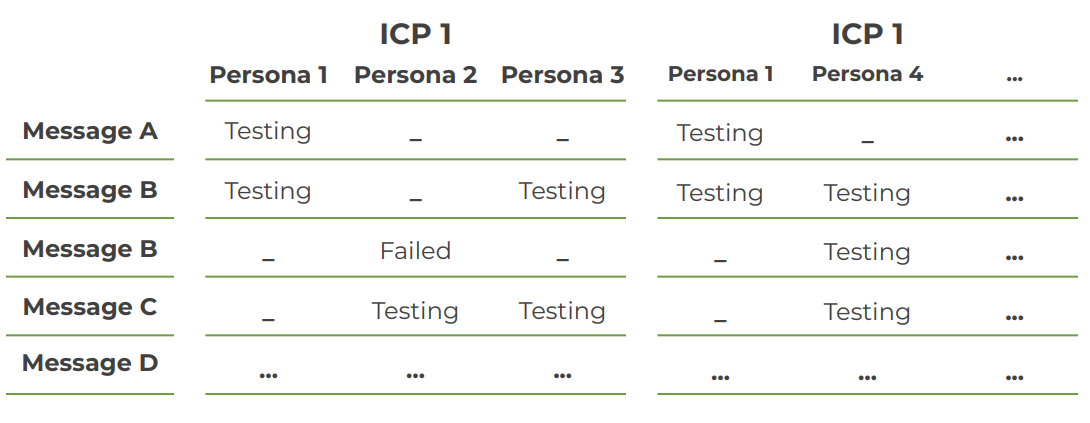
One approach Reditus uses is a PMF Matrix, which places ICP and persona categories in the columns and key messages in the rows. Each intersection becomes a point of market testing, allowing the founder to observe which combinations produce real interest and which do not. This structure removes guesswork and helps prevent the common tendency to chase too many segments at once.
Message A
Message B
Message C
Message D
Message E
–
ICP 1
–
Persona 1
Persona 2
Persona 3
Testing
–
–
Testing
–
Testing
–
Failed
–
–
Testing
Testing
…
…
…
–
ICP 1
–
Persona 1
Persona 4
…
Testing
–
…
Testing
Testing
…
–
Testing
…
–
Testing
…
…
…
…
Table 1: Sample PMF Matrix
There is a strategic tradeoff in how founders test their PMF Matrix. Testing one ICP-persona-message combination at a time preserves focus and reduces resource strain, but it increases the risk of slow cycles if the first few combinations don’t reveal a pattern.
Testing several combinations in parallel speeds up learning but requires more coordination, more message discipline, and clearer tracking. The
choice is not about the “correct” number of tests, but about balancing focus, cost, and speed. What matters is capturing enough evidence to confirm a repeatable pattern without diluting the learning across too many segments at once.
To turn the PMF Matrix into a measurable test, the model focuses on buyer behaviors that reliably indicate real interest. Not all early prospects will move all the way through a full buying cycle, but they do reveal whether the problem matters, whether budget is available, and whether the stakeholder has authority. These signals form the minimum standard of meaningful engagement.
Using this standard, the model defines PMF as generating five partial BANT leads from the same ICP, persona, and message combination. This shifts the discussion from subjective opinions about fit to observable buyer behavior.
In this context, partial BANT refers to Budget, Authority, and Need. Timing (the “T”) is not required at this stage because timing often depends on internal cycles such as fiscal calendars, legal reviews, or competing priorities that are outside the startup’s control. Teams need to confirm that Timing is indeed the blocker, and not a buyer excuse.
When five prospects from the same ICP and persona show Budget, Authority, and Need, the startup has strong evidence that the value proposition resonates with a real, addressable segment of the market, even if the timeline varies. BAN is enough to prove the pattern.
The number is large enough to reveal a recognizable pattern and small enough to identify misalignment quickly. PMF is not about scale. It is about clarity.
A company remains in the PMF stage if it has not yet generated five partial BANT leads from a single, well defined customer segment using a specific message. Without this repeatable pattern, the startup cannot reliably predict who will engage or why. Attempts to build a go-to- market motion at this point often lead to wasted effort because the foundational pattern has not been confirmed.
The gate for exiting PMF is simple and empirical. The startup must have:

five partial BANT leads,
from the same ICP, persona, and message.
If PMF does not produce a clear, repeatable ICP–persona–message pattern, the startup enters Go-to-Market without the focus required to build a motion that converts, leading to wasted spend, inconsistent results, and early hires who cannot succeed.
Startup Lifecycle Whitepaper
Read about the six-step startup lifecycle model defined by Reditus in this free whitepaper.
Get in Touch
If what you’ve read here resonates, begin with a quick check on fit.
No pitch. No pressure. Just context.