
Reditus B2B Buyer Model | Section 5
Consequence Tolerance and Decision Viability
Action is possible only where at least one option remains tolerable. When none do, the buying system produces inaction.
From the paper
The proposal had been approved once already.
Not formally. Not with signatures. But in the way that mattered. Heads had nodded. Calendars had been tentatively cleared. The vendor had been told to expect next steps.
Two months earlier, the timing had felt right.
The VP of Operations had bandwidth. The compliance lead had political capital after a clean audit. Finance had room in the quarter. No one was under acute pressure. The implementation plan felt demanding but manageable.
Then things shifted.
A customer escalation consumed Operations for weeks. A surprise audit finding pulled Compliance into daily remediation calls. Finance froze discretionary spend after missing a forecast.
None of this had anything to do with the proposal.
When the group reconvened, the deck was the same. The value case hadn’t changed. The risks were understood. The vendor hadn’t moved.
But the energy in the room was different.
Operations spoke first. “I can’t take this on right now,” he said. “Not because it’s a bad idea. Because my team is already stretched.”
Compliance nodded. “I agree with the direction,” she said. “But until this audit is behind us, I can’t absorb the risk of introducing something new.”
Finance added, “If we wait until next quarter, it’s cleaner from a budgeting standpoint.”
The sponsor tried to regroup. “Could we narrow the scope?” he asked. “Just get started?”
That suggestion had worked in other contexts. Here, it landed flat.
“Narrowing scope doesn’t narrow responsibility,” Operations said. “If something breaks, it’s still on us.”
No one argued.
They explored alternatives. Pilot programs. Parallel evaluations. Internal stopgaps. Each option was discussed seriously. Each one, in turn, ran into the same invisible boundary.
It wasn’t that people disagreed.
It was that nothing fit anymore.
The meeting ended without a decision. Not postponed in name, just… unresolved.
Later, someone summarized it in an email: Let’s revisit when things settle down.
No one responded.
The system hadn’t chosen against the proposal. It hadn’t chosen at all.
The decision that had once felt viable no longer was.
Not because the proposal had changed.
But because the space in which it could be tolerated had.
Once personal consequence is evaluated through identity utility and selfish utility, the question shifts: not why individuals behave as they do, but when action is possible at all.
In complex buying decisions, action is not chosen from an open set of possibilities. It is constrained.
Each individual operates within a limited range of consequences they can accept. Outside that range, action is not feasible, regardless of organizational value or rational justification.
This model does not predict specific outcomes. It predicts which kinds of interventions cannot produce outcomes unless perceived consequence changes.
How Tolerance Defines Viability
For any given individual, consequence exists as a two-dimensional space:
- One dimension reflects identity utility; how well the decision aligns with the individual’s narrative, social, and aspirational identity.
- The other reflects selfish utility; the personal impact of the decision in terms of exposure, effort, risk, quality of life, and reversibility.
Within this space, each individual has a tolerance curve.
Identity UtilitySelfish UtilityNot-Viable RegionDecision Not ViableViable RegionDecision SurvivesTolerance CurveConceptual model. Real tolerance is dynamic and inferred, not directly measurable.
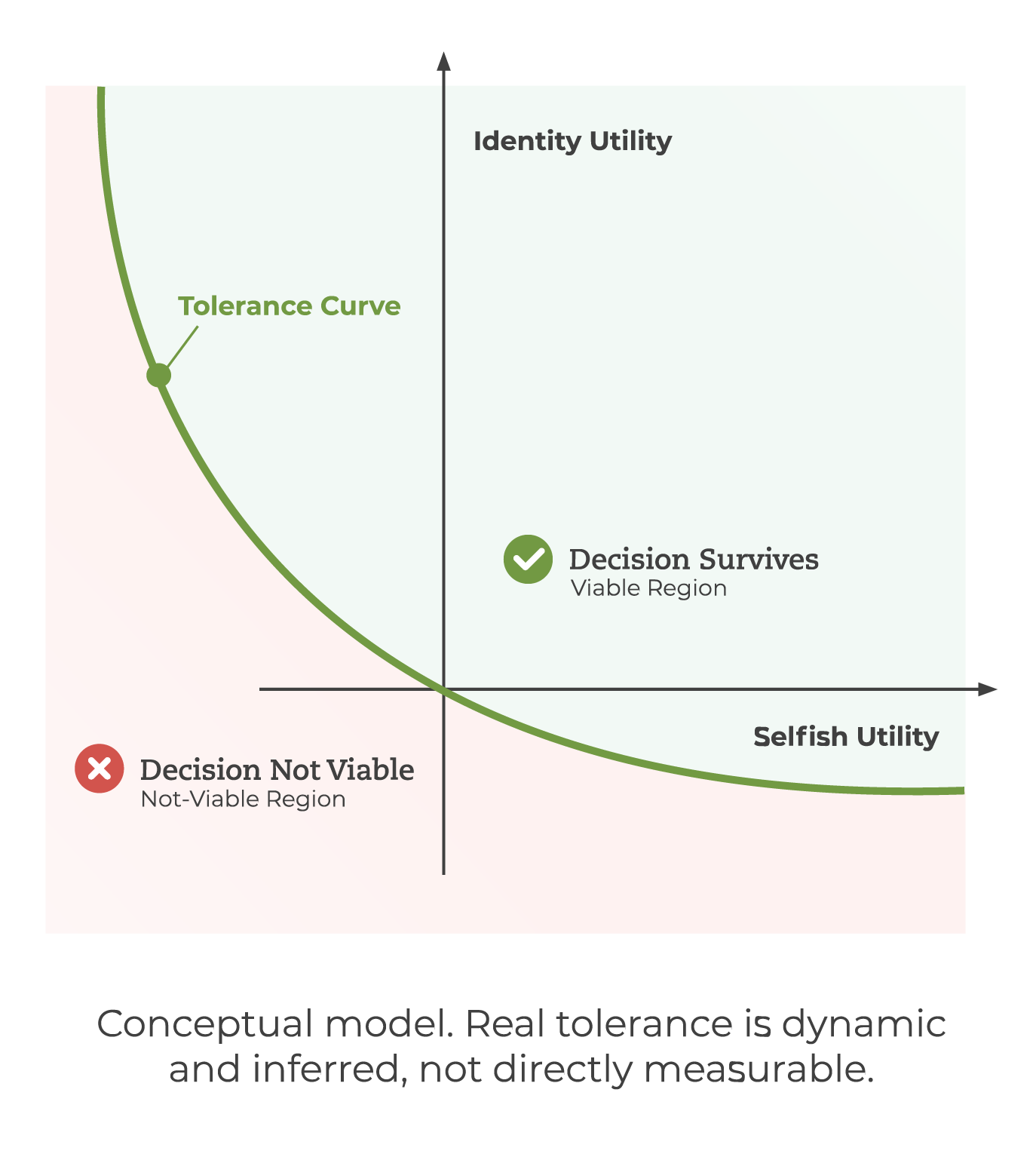
Combinations of identity utility and selfish utility that fall on one side of the curve are survivable. Those that fall on the other are not.
This curve is not fixed, symmetric, or linear. It is shaped by role, context, timing, and recent experience.
Why Tolerance Is Individual and Time-Specific
An individual’s tolerance curve is not a trait. It is situational.
Factors that reshape it include:
- Current workload and cognitive load
- Recent successes or failures
- Available political capital and credibility
- Proximity to audits, reviews, or promotions
As these conditions change, the same proposal can move from acceptable to unacceptable without any change in its objective merits.
This explains why identical proposals are approved in one quarter and rejected in the next.
Why Committees Fragment
Decision momentum depends on the overlap among individual tolerance curves. When tolerance curves overlap sufficiently, a viable action exists for all participants simultaneously. When they do not overlap, the committee cannot converge – not because of disagreement over value, but because no available action satisfies all individual constraints at the same time.
Attempts to force convergence without changing how consequence is distributed lead to delay, distortion, or quiet rejection.
Action is possible only where at least one option remains tolerable. When none do, the system produces inaction.
What the Tolerance Model Explains
The tolerance framework explains several common but poorly understood patterns in complex deals:
- Why acknowledged value does not produce action
- Why safer options beat objectively better ones
- Why pilots and partial commitments dominate
- Why escalation increases rather than resolves friction
- Why persuasion loses effectiveness late in the process
- Why timing objections recur without resolution
In each case, the system is operating within limits, not indecision.
Implication
Once identity utility and selfish utility define how consequence is evaluated, outcomes are bounded. The system can only select from options that fall within tolerance, regardless of organizational merit.
What emerges is not the best possible decision, but the best decision the system can accept at that moment in time.
Understanding complex buying behavior therefore requires understanding not just what buyers want, but what the system allows.
FOUNDATIONAL PAPER
The Reditus B2B Buyer Model
Consequence, Power, and Decision Emergence in Complex B2B Buying. Read the complete paper by Craig T. Watkins.
Get in Touch
If what you’ve read here resonates, begin with a quick check on fit.
No pitch. No pressure. Just context.