
REDITUS STARTUP LIFECYCLE
Stage 4: Go-to-Market
A company exits GTM when it demonstrates a functioning early revenue motion that reliably generates pipeline and converts opportunities, and when it has meaningful Closed Won revenue or sufficient external funding to support building a repeatable revenue system.

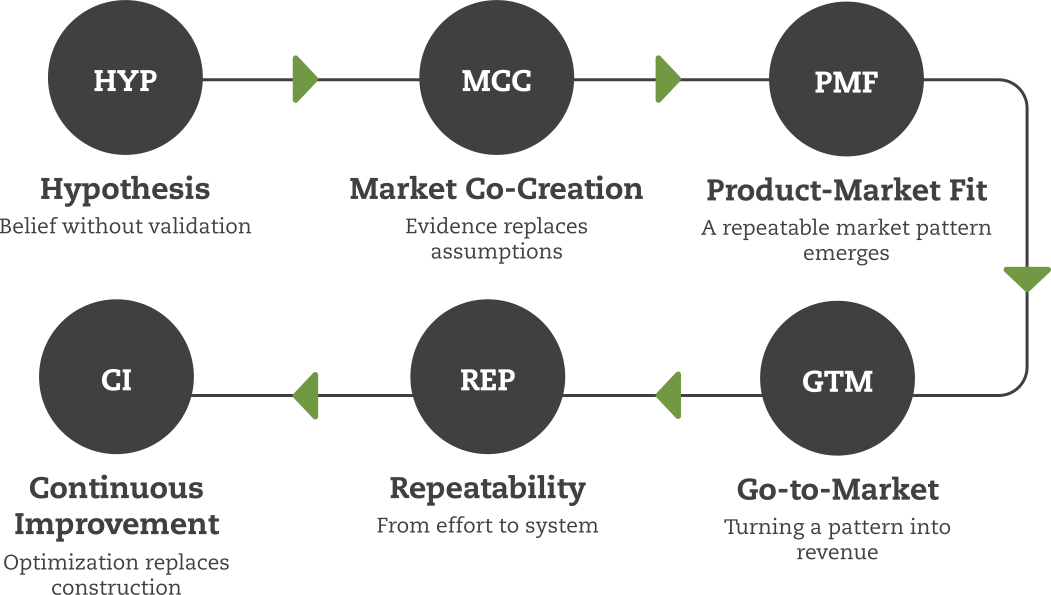
The Go-to-Market (GTM) stage begins once the startup has demonstrated a clear and repeatable pattern of interest through Product-Market Fit. At this point, the company has validated which ICP and persona respond to the message, and it has verified that the problem, value, and need are consistent within that segment. The purpose of GTM is to convert this validated pattern into early revenue and pipeline development.
In GTM, the startup builds an initial motion that brings the value proposition to market in a structured and repeatable manner. This includes selecting the channels that align with buyer behavior, defining the outreach approach, refining the message for scale, and establishing the early steps of the customer journey.
The founder still participates in key conversations and supports the early GTM team, but the focus shifts from proving the pattern to enabling others to operate it. The work becomes more operational and less exploratory.
Pipeline mechanics without funding = no system build.
Funding without pipeline mechanics = scaling a motion that is not ready.
GTM is not the stage for broad scaling or team expansion. The goal is consistent opportunity creation, not volume. What matters is that the company can create early pipeline and convert opportunities in a way that reflects the PMF pattern. GTM also provides the data needed to begin designing the systems that will be required in later stages. These systems include forecasting, pipeline management, and the initial structure of sales and marketing workflows.
A startup remains in the GTM stage until it has A) evidence the early GTM motion works, and B) reached either a level of revenue or funding that can support the cost of building a repeatable revenue system.
Specifically:
A. Evidence that the early GTM motion actually works:
- The company can generate pipeline using the validated PMF pattern
- The pipeline is not accidental or based entirely on the founder network
- There are clear steps in the customer journey
- Early conversion (even small) demonstrates that buyers move through the motion
- Messaging and channels are performing with predictable pipeline generation
This shows that the PMF pattern translates into real buying behavior, not just interest.
B. Evidence that the company can afford to build the system required in Stage 5:
- Meaningful Closed Won revenue or
- Enough external capital to fund system creation
This ensures the company can actually execute the Repeatability stage.
You need both A and B.
If GTM does not prove that the motion reliably converts into revenue, the startup enters Repeatability with no consistent pattern to scale and ends up scaling noise, driving cost without focus. If the company also lacks enough revenue or capital to fund Repeatability, it enters the stage constrained and unable to build the systems required for sustainable growth.
Startup Lifecycle Whitepaper
Read about the six-step startup lifecycle model defined by Reditus in this free whitepaper.
Get in Touch
If what you’ve read here resonates, begin with a quick check on fit.
No pitch. No pressure. Just context.