
REDITUS STARTUP LIFECYCLE
Stage 6: Continuous Improvement
A company enters Continuous Improvement once the revenue system is stable, documented, and fully owned by established leadership.

The Continuous Improvement stage begins once the revenue engine is built, documented, and led by individuals who can operate it consistently. At this point, the company no longer needs to establish foundational processes. Instead, the focus shifts to refining the system, maintaining alignment with the market, and improving performance over time. Continuous Improvement ensures the revenue engine remains healthy as the organization grows and as external conditions change.
The purpose of this stage is to create a cycle of evaluation and adjustment. Markets evolve, products extend into new use cases, and buying behavior shifts. Continuous Improvement provides a structured way to monitor these changes and to ensure that the revenue system remains connected to current market signals. This work helps prevent drift, where the system becomes outdated or misaligned with buyer needs.
Key activities in this stage include reviewing pipeline data, identifying bottlenecks in the sales process, refining messaging, adjusting ICP or persona definitions, and updating playbooks or workflows. Leadership evaluates conversion rates, examines the performance of channels, and makes targeted improvements. The company also strengthens enablement and ensures that new team members can integrate smoothly into the system.
A company remains in Continuous Improvement through the remainder of its lifecycle. This stage does not end. Instead, it provides the operational discipline that supports sustained growth.
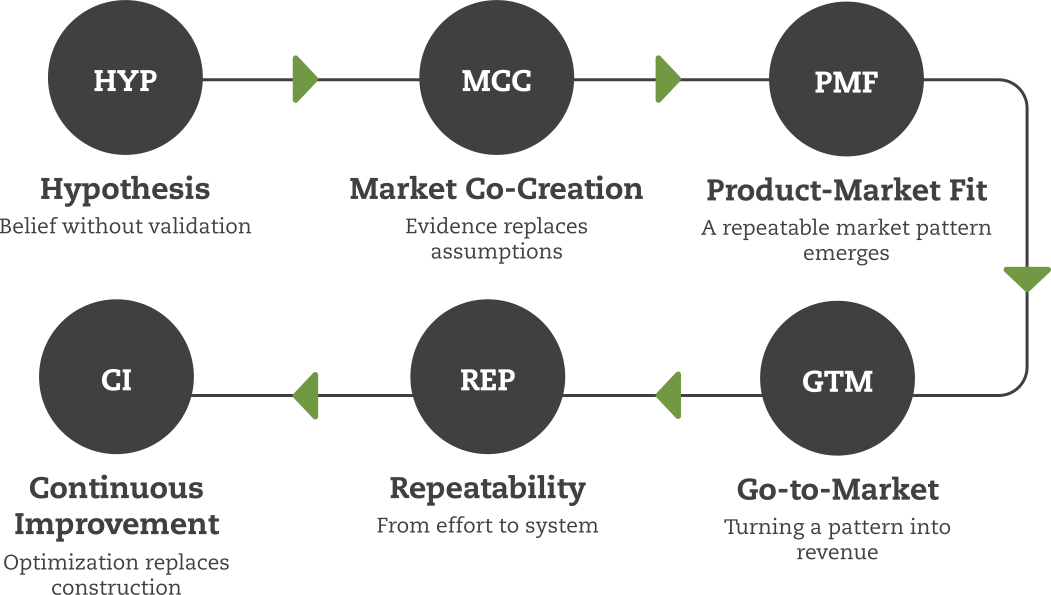
However, companies should occasionally revisit earlier stages if major shifts occur, such as the introduction of a new product line or a move into a new market segment. In those cases, elements of Hypothesis, Market Co-Creation, or Product-Market Fit should be revisited with the same rigor as in the initial journey.
The gate for entering Continuous Improvement is the successful transition of system ownership from the founder to established revenue leadership. Once the revenue engine is stable, documented, and operated by a capable team, the company has the foundation needed to focus on optimization rather than construction.
With Continuous Improvement in place, the startup has completed the foundational lifecycle and can operate with clarity and discipline. Entering this stage deliberately matters because optimization only works when the underlying system is stable. Without a conscious shift into Continuous Improvement, growth remains reactive and the company risks slipping back into heroics.
Startup Lifecycle Whitepaper
Read about the six-step startup lifecycle model defined by Reditus in this free whitepaper.
Get in Touch
If what you’ve read here resonates, begin with a quick check on fit.
No pitch. No pressure. Just context.