The Revenue River
Revenue rarely moves in a straight line. This revenue waterfall chart shows how your Annual Recurring Revenue changes over a given period, breaking down exactly where growth and loss occur. For any recurring revenue business, it’s an essential tool for decisions about growth, customer retention, and customer success.
ARR Waterfall 101 – What It Is and Why It Matters
The ARR Waterfall Chart shows revenue over a defined period, capturing expansions, contractions, upgrades, and churn. Rather than a single ending number, it shows how ARR shifts through new sales, churn, downgrades, and upsells (also called expansion ARR). These shifts support smarter decisions for any subscription revenue model, from deferred revenue to recognized revenue.
For fractional CCOs and other part-time executive roles, the ARR Waterfall offers a fast, reliable way to track recurring revenue and guide customer-focused strategy. At Reditus, it’s a key tool for revenue recognition and understanding revenue generated across existing customers, without a full-time team.
Download the file HERE
Breaking Down the Waterfall – Components Explained
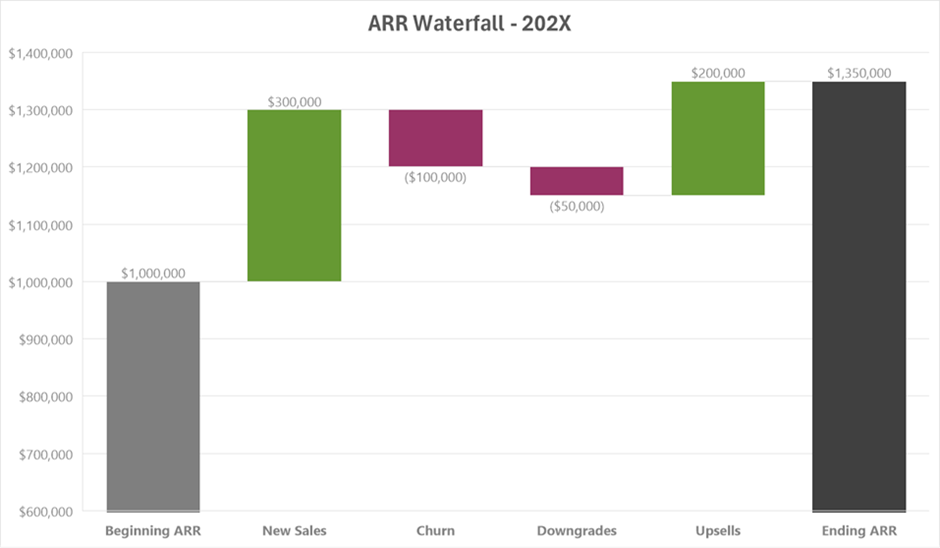
Let’s walk through the components of an ARR Waterfall Chart using the example above:
- Beginning ARR: This is your starting point: the baseline Annual Recurring Revenue ARR for the chosen period, giving you a foundation for tracking growth over time.
- New Sales: Revenue from new customers who pay: a direct signal of how well your growth strategy resonates with the market, and it eases pressure on customer success to offset weak acquisition.
- Churn: The ARR churned, or ARR lost to complete cancellations, is one of the clearest signals of product-market-fit or onboarding problems. We track it separately from downgrades, since churn means a complete exit.
- Downgrades: Reduced spend from customers who stay active. It often signals short-term budget pressure, not unhappiness, and a chance for customer success to step in before they churn.
- Upsells: Additional revenue from customers upgrading to higher-value plans, also called expansion ARR. Strong upsell and cross-sell performance is a reliable signal of customer satisfaction.
- Ending ARR: After accounting for new sales, churn, downgrades, and upsells, you reach your Ending ARR. This is your revenue strength heading into the next period.
Why the ARR Waterfall Matters for SaaS Business Models

The ARR Waterfall is a strategic tool, not just a financial report. It connects revenue growth with customer behavior and helps any recurring revenue business improve retention and lower acquisition costs.
- Aligning Revenue Goals with Customer Service: Understanding how ARR changes over time reveals customer churn, expansion patterns, and where the user experience needs work.
- Supporting Fractional CCO Decisions: A Fractional Chief Customer Officer relies on this data to guide retention, expansion, and cross-functional decisions without a full-time team.
- Adaptable for any SaaS Company: Whether you’re early-stage or scaling fast, a saas revenue waterfall creates transparency for any recurring revenue business model.
- Reveals the customer journey: Patterns like stalled expansions or downgrades often signal friction before it becomes churn.
- Sharpens financial planning: Investors, finance teams, and leaders depend on reliable, revenues based ARR tracking, revenue recognition, and net revenue retention NRR for accurate forecasting.
Conclusion: ARR Waterfall – A SaaS Essential
The ARR Waterfall Chart is essential for SaaS growth. Few tools track revenue changes and existing-customer behavior this clearly. By tracking churn and downgrades separately, customer success teams can act early. Whether you’re evaluating a fractional CCO or refining your SaaS business model, the waterfall gives you a clear, actionable view of how revenue actually behaves.
FAQ: ARR Waterfall and SaaS Growth
What is an ARR Waterfall Chart?
A simple visual showing how Annual Recurring Revenue changes over a period: new sales, churn, downgrades, upsells, and ending ARR. It’s used to understand revenue streams and customer retention.
How does the ARR Waterfall help SaaS growth?
It shows whether growth comes from new customers, upsells, or reduced churn, supporting better business decisions and long-term planning.
Why track churn rate separately from downgrades?
Churn means customers left entirely; downgrades means they stayed but spend less. Separating them helps customer success protect revenue and improve the user experience.
Can the ARR Waterfall help with understanding product market fit?
Yes. In early stage SaaS, patterns in churn, downgrades, and slow expansions often reveal product market fit issues. If customers do not expand or refer others, your offering may not be strong enough yet.
How does the ARR Waterfall support customer success?
It identifies which customers are expanding, which are contracting, and which are at risk. This allows customer success teams to focus on retention, improve customer journeys, and drive upsell or cross sell opportunities.
Does the ARR Waterfall help reduce customer acquisition costs?
Indirectly yes. When existing customers expand more reliably, you do not have to rely as heavily on acquiring new customers to drive SaaS growth. Strong retention and expansion reduce pressure on CAC.
Is the ARR Waterfall useful for early stage SaaS companies?
Absolutely. Early stage SaaS teams gain valuable insights by tracking even small changes in ARR. The chart reveals weak spots in onboarding, adoption, user experience, or pricing.
How often should a SaaS company review its ARR Waterfall?
Most companies track monthly recurring revenue and review the ARR Waterfall monthly or quarterly. High growth teams often check it monthly because rapid shifts in customer behavior can impact revenue generated quickly.
