

Reditus B2B Buyer Model
What is the Reditus B2B Buyer Model?
A first-principle model of consequence, power, and decision emergence in complex B2B buying.
Complex buying systems cannot optimize for value. They can only produce outcomes that fall within the overlapping tolerance of the individuals who bear consequence.
Why Did We Build the B2B Buyer Model?
Complex B2B purchases stall even when value is clear, champions are engaged, and ROI is proven. Traditional explanations such as indecisive buyers, insufficient urgency, and weak messaging fail to predict which deals will close and which will collapse. The Reditus B2B Buyer Model offers a structural explanation.
The patterns described in the model emerge from decades of direct involvement in complex B2B sales and marketing, including firsthand exposure to thousands of enterprise buying systems across industries and organizational contexts. The intent is not to prescribe tactics, but to explain why complex buying systems behave as they do.
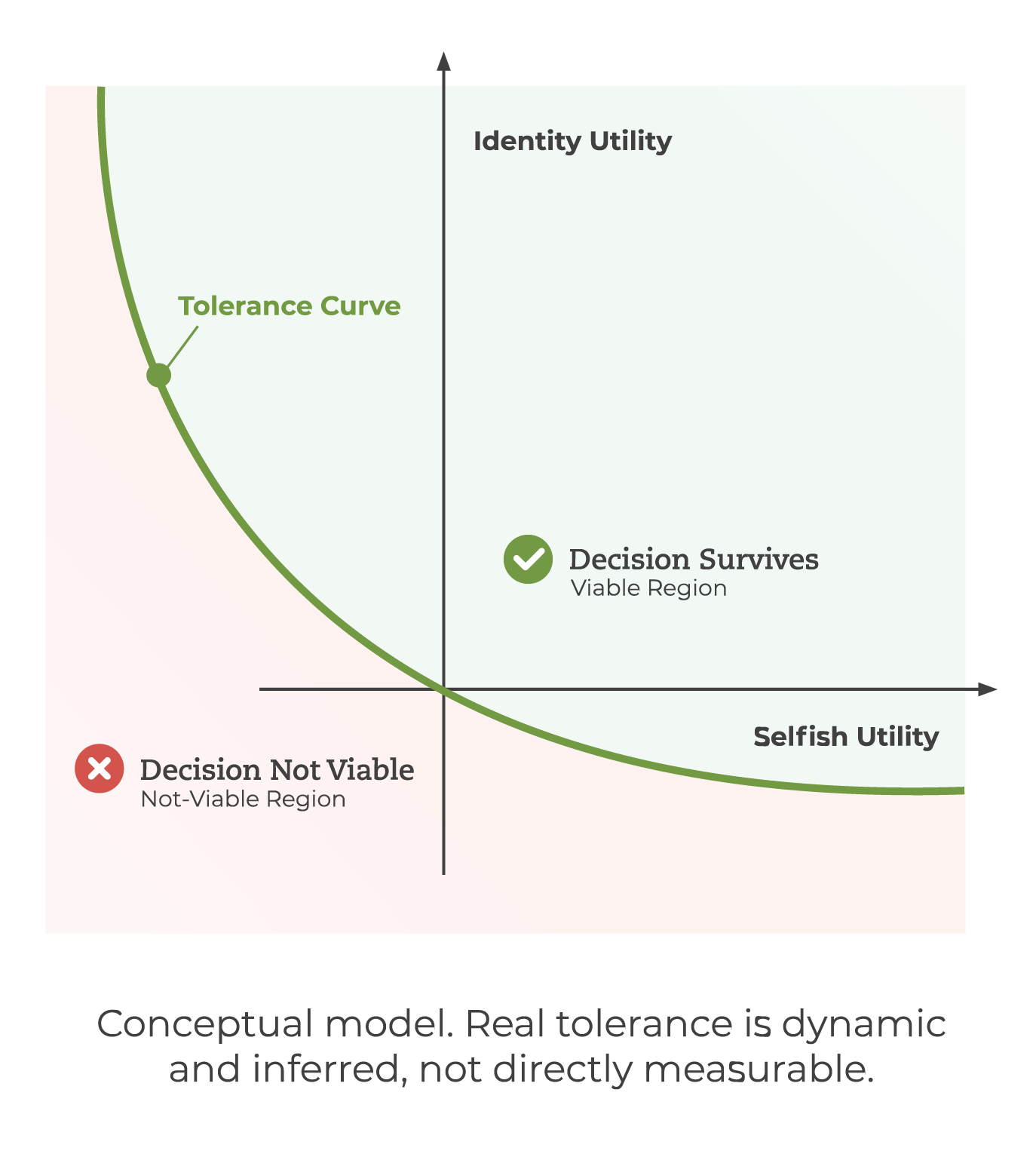
Complex buying is not a single rational decision made by a unified committee. It is the emergent result of multiple individuals, each evaluating personal consequence through two independent dimensions: what the decision does to them, selfish utility, and what it says about them, identity utility. These evaluations create tolerance curves, boundaries beyond which action becomes impossible regardless of organizational value.
When tolerance curves do not overlap across required decision-makers, no amount of persuasion, ROI demonstration, or executive sponsorship will force convergence. The buying system cannot produce outcomes that exceed what participants can personally tolerate. This explains persistent patterns such as why safer options beat better ones, why decisions collapse late without new information, why “do nothing” dominates, and why timing matters more than logic predicts.
This model is intended for senior revenue practitioners, their leadership, startup founders, and buyers who need to understand why complex deals behave as they do and what expertise looks like when current frameworks, playbooks, and linear process are no longer sufficient.
The Model Map
The Reditus B2B Buyer Model shows why complex buying systems cannot optimize for value; they can only produce outcomes that fall within the overlapping tolerance of the individuals who bear consequence.

Complex decisions are committee decisions.
Decision power lies in whomever bears consequence. Organizations bear outcomes. Individuals bear consequence.

Individuals evaluate consequence in two dimensions.
Identity Utility and Selfish Utility.

Each individual has a tolerance curve.
In that two-dimensional space, the tolerance curve defines decision survivability at a point in time.

Each decision contains multiple embedded decisions.
Act or don’t act, build vs buy, which vendor: each mapped in that same space.

The final outcome emerges.
It emerges from the set of decisions that survives tolerance for all individuals with consequence.
Horse-trading between individuals moves consequence, tolerance curves, and perceived utilities of decisions.
This model explains why decisions are hard, who decides, and why nothing moves.
The Nine Sections of the Model
The Reditus B2B Buyer Model is a single argument built section by section. Each section extends the last. Explore each one in full, or read the complete Foundational Paper.
section 1
section 2
section 3
section 4
section 5
Action is possible only where at least one option remains tolerable.
section 6
Act or not. Build or buy. Which vendor.
section 7
section 8
section 9
appendix
What the Model Concludes
Complex B2B buying cannot be explained by persuasion, preference, or rational comparison. It is the emergent result of how consequence is distributed, how individuals evaluate that consequence through identity and selfish utility, and how tolerance curves overlap across multiple decisions and multiple people.
The patterns this model predicts, persistent inaction, late-stage collapse, safer choices dominating better ones, timing sensitivity without new information, are not failures of process or professionalism. They are structural outputs of constrained systems.
Traditional buying models work in simple contexts where a single decision-maker has authority. They fail in complex environments because they cannot explain why acknowledged value doesn’t produce action, why identical proposals succeed in one quarter and fail in the next, or why committees fragment without disagreement.
This model explains all of these. Not as anomalies, but as predictable outcomes.
This model does not offer a playbook. It offers a way to see. Those who learn to see tolerance curves, consequence distribution, and emergence can shape outcomes others cannot, not by forcing decisions, but by managing the conditions under which decisions become possible.
That requires judgment built through repeated exposure to many systems under different constraints. It cannot be reduced to process. It cannot be delegated to inexperience. It is expertise.
Complex buying systems do not reward simplicity. They reward disciplined engagement with complexity.
FOUNDATIONAL PAPER
The Reditus B2B Buyer Model
Consequence, Power, and Decision Emergence in Complex B2B Buying. Read the complete paper by Craig T. Watkins.
Get in Touch
If what you’ve read here resonates, begin with a quick check on fit.
No pitch. No pressure. Just context.